Conformation
While light scattering does not provide high-resolution images of nanoparticles, it is an effective means of learning about the distributions of shapes or…
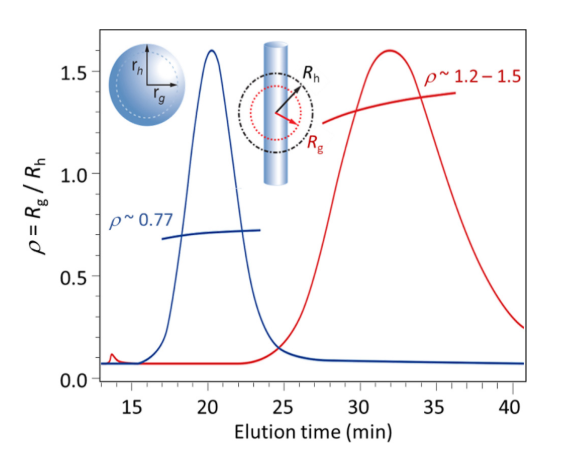
While light scattering does not provide high-resolution images of nanoparticles, it is an effective means of learning about the distributions of shapes or other conformational properties in particle ensembles. This is accomplished using three devices: an Eclipse FFF separation system, a DAWN MALS detector, and a WyattQELS DLS module integrated into the DAWN.
FFF separates the particles by size. As each elution volume enters the DAWN, light scattering makes two independent measurements: the rms radius Rg, by means of MALS, and the hydrodynamic radius Rh, by means of DLS. The ratio Rg:Rh, known as the 'shape factor,' provides an indication of a primary structural parameter.
Some a priori information about the expected shape is required for proper interpretation of the shape factor. If the particles are known to be elliptical and of uniform composition, the shape factor indicates the degree of deviation from sphericity and the axial ratio. If the particles are known to be spherical but may be hollow shells or uniform spheres, the shape factor indicates the actual conformation, and likewise for a variety of simple, well-defined structures.