Size Distributions
DLS is a common means for estimating the size of nanoparticle and other colloidal suspensions, and even obtaining a low-resolution size distribution, in all…
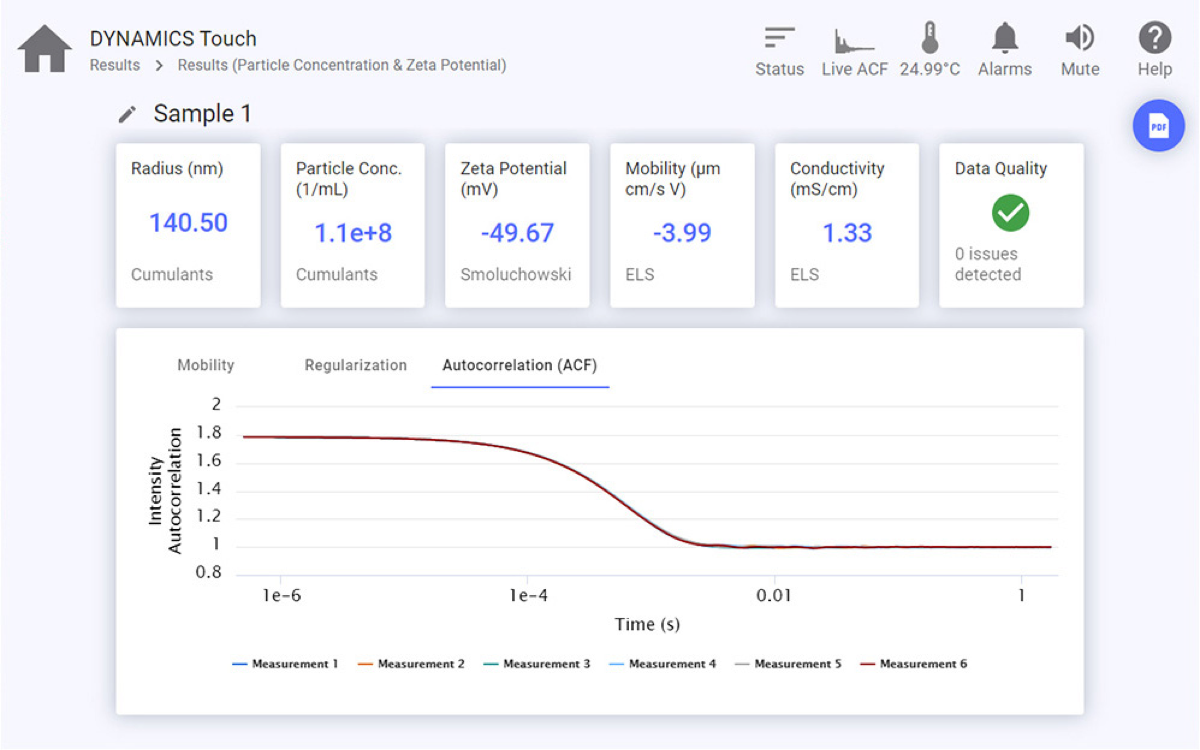
DLS is a common means for estimating the size of nanoparticle and other colloidal suspensions, and even obtaining a low-resolution size distribution, in all kinds of solvents and in relatively short time.
However, the majority of DLS instruments require you to manually fill a cuvette with sample, insert the cuvette into the instrument, operate the software to begin data collection, then wash the cuvette and repeat the entire procedure with the next sample – a slow and laborious process. Wyatt offers two methods of automating DLS so you can set and forget dozens or even hundreds of samples, freeing you up to do other things and increasing productivity ten-fold.
The DynaPro™ Plate Reader performs DLS measurements in situ in standard microwell plates containing 96, 384 and even 1536 samples, completing hundreds or thousands of samples per day.
The ZetaStar™, combining simultaneous DLS and electrophoretic mobility measurements to determine size and zeta potential, can be connected to standard autosamplers and HPLC pumps in order to automate dozens of size and zeta potential measurements. The ZetaStar works with organic and aqueous solvents.
If automation is not needed, the DynaPro NanoStar™ offers convenient cuvette-based DLS measurements over a very wide temperature range and with sample volume as small as 2 µL.
When accurate, high-resolution size distributions of nanoparticle suspensions are necessary, the analytical tool of choice is Field-Flow Fractionation (FFF) using an Eclipse™ FFF system, coupled to a DAWN™ MALS detector with an optional integrated WyattQELS™ DLS module. The NanoStar can also provide on-line DLS detection in conjunction with a Wyatt MALS detector, then easily be switched back to cuvette-based DLS.
FFF is conceptually related to size-exclusion chromatography, yet provides separation performance well beyond that of SEC, spanning the range of 1 – 1000 nm with excellent resolution. Whereas unfractionated DLS at best distinguishes particles that differ in size by 3-5x, FFF-MALS and FFF-DLS can characterize accurately particles that differ in size by just a few percent.