ElectroForce Mechanical Test Instruments
Mechanical testing includes a wide variety of testing techniques that aim to either characterize a material’s mechanical properties or determine a structure’s response to a specific force. Mechanical testing is a standard and crucial part of the design and manufacture of any product. From medical implants to airplane wings, all materials can be verified as safe and efficient for their application through mechanical testing.
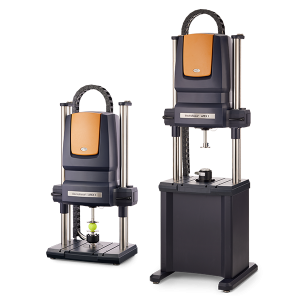
Load Frames
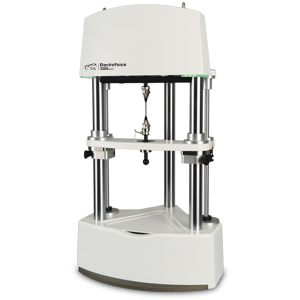
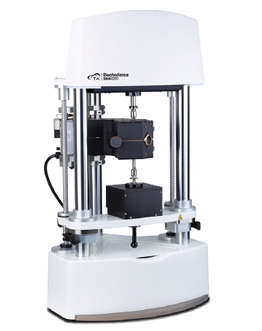
6 productsMechanical tests performed using load frames reveal important stiffness, strength, and durability characteristics of test samples, often pushing samples to failure to determine yield strength, ultimate strength and fatigue life. Test samples range from materials to subcomponents to complete components/products. Loading is applied by linear motors with a variety of loading profiles. These profiles can be a single push- or pull-to-failure such as a classic ‘tensile test’, repetitive loading for fatigue, or creep/stress-relaxation measurements. Environmental effects can be evaluated by testing in temperature-controlled air, gas, or fluid submersion. Occasionally, more complex modes such as axial-torsion loading are used to characterize samples in various combined states of stress and strain.
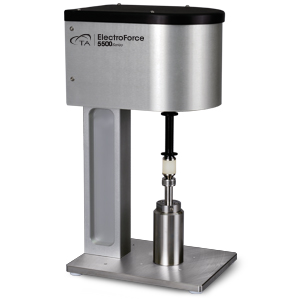
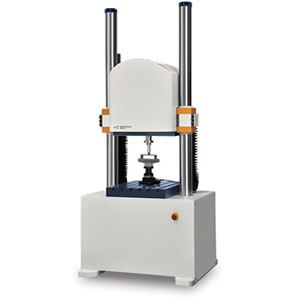
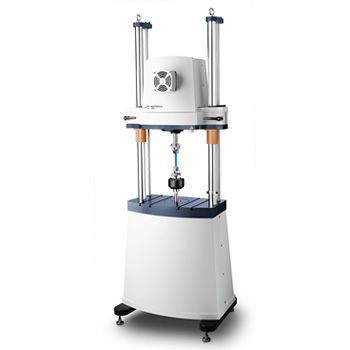
Multi-Specimen Fatigue
1 productshttps://www.youtube.com/watch?v=bh2ApeDU8bI
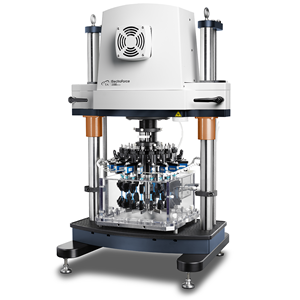
Durability testing can take a long time, especially when the material or product is expected to last for many years and a high number of cycles. Multi-specimen fatigue shortens durability test time by simultaneously applying cyclic displacement to many samples and detecting each sample’s cycles-to-failure for the applied loading level. This allows users to generate many failure datapoints for each loading level. When multiple tests are run on similar samples, researchers can quickly build SN curves (S-n Curves) with many data points to improve statistical confidence levels of the resulting fatigue model. Otherwise, these millions, 10s of millions and even 100s of million cycle-long tests can extend product development time and hinder efforts to accelerate time to market of new materials and products.
TestBench & Planar Biaxial
2 productshttps://www.youtube.com/watch?v=bh2ApeDU8bI
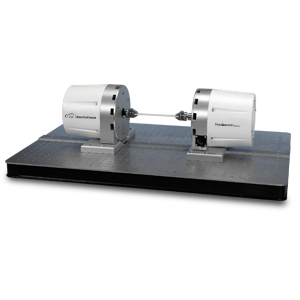
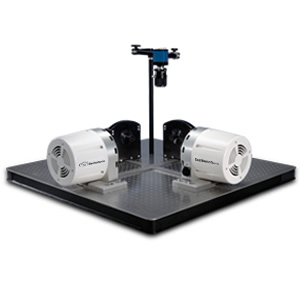
TestBench instruments are used to perform tests similar to Load Frames since they also reveal important stiffness, strength, and durability characteristics of test samples, often pushing samples to failure to determine yield strength, ultimate strength and fatigue life. Test samples range from materials to subcomponents to complete components/products. Loading is applied by linear motors with a variety of loading profiles. These profiles can be a single push or pull-to-failure such as a classic ‘tensile test’, repetitive loading for fatigue, or creep/stress-relaxation measurements. Environmental effects can be evaluated by testing in fluid submersion. Occasionally, more complex modes such as axial-torsion or planar biaxial loading are used to characterize samples in various states of stress and strain, including evaluating material anisotropy.
Cardiovascular Device Fatigue
3 productshttps://www.youtube.com/watch?v=bh2ApeDU8bI
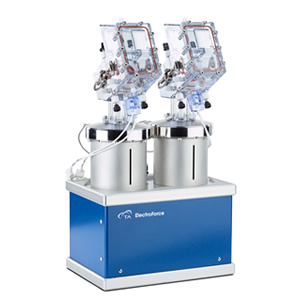
Medical device testing is often aimed at evaluating a medical device’s risk of failure in patients, which is critical when device failure could result in serious harm or death. Durability testing is particularly important when implantable medical devices are intended for multi-year use and experience repeated stress and strain cycles. Cardiovascular devices such as stents, heart valves and other endovascular devices not only experience substantial stress or strain during each heartbeat cycle, but they must resist this loading repeatedly for approximately 400 million cycles for a 10-year lifetime, and 600 million for 15-year lifetime. In vitro fatigue testing to evaluate device durability against heartbeat loading is crucial for device manufacturers to gain regulatory approval such as per US FDA, European MDR and Chinese FDA requirements.
Dynamic Mechanical Analyzers (DMA)
6 productshttps://www.youtube.com/watch?v=egR8QpDcZOg
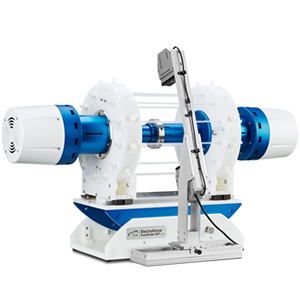
Dynamic Mechanical Analyzers (DMA) measure the mechanical properties of materials as a function of time, temperature, and frequency. In addition to quantifying viscoelastic properties of materials, DMA can also quantify finished component and product characteristics, reflecting the important contribution that processing has on end-use product performance. DMA is commonly used to measure glass transition temperatures (Tg) and secondary transitions, orientation caused by processing, cold crystallization, cure optimization, filler effects in composites, and much more. DMA provides an accurate measure of material modulus and product stiffness plus other important mechanical properties such as damping, creep, and stress relaxation. A Dynamic Mechanical Analyzer is a mechanical instrument that applies specific displacement or force to a sample and very accurately quantifies its force versus displacement response. Its measurements extend beyond simply quantifying the magnitude of force divided by the displacement magnitude; it accurately calculates the phase relationship between the signals. This enables a DMA instrument to quantify the elastic (spring-like) versus viscous (fluid-like) components of the sample response which is crucial for reliable and complete viscoelastic property characterization such as Storage Modulus, Loss Modulus, and Tan delta. These viscoelastic properties are almost always evaluated over a range of temperatures, using oven and cooling accessories, which then can provide many insights into structure-property relationships and how materials perform at different use temperatures. Some advanced methods include TTS (Time-Temperature Superposition), curing studies, creep-recovery, and stress-relaxation analysis.