Branching & Conformation
Design and control of polymer branching permit the creation of synthetic materials with novel mechanical, thermal and rheological properties. The most reliable…
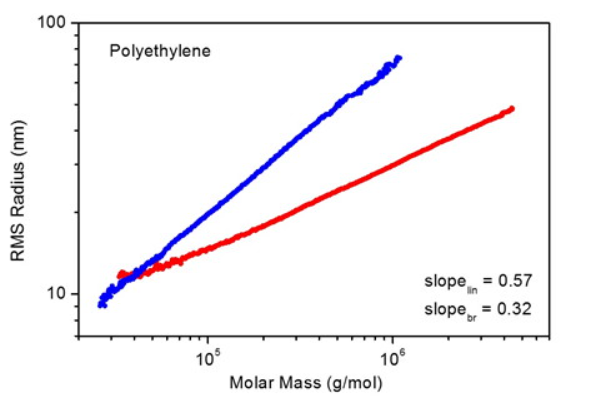
Design and control of polymer branching permit the creation of synthetic materials with novel mechanical, thermal and rheological properties. The most reliable means of evaluating branching in all types of polymers is multi-angle light scattering, as described by Dr. Stepan Podzimek in 'Branching Revealed: Characterizing Molecular Structure in Synthetic and Natural Polymers by Multi-Angle Light Scattering' (Application Note and On-Demand Webinar).
Branching ratio is determined through the relationship between molar mass and size; both are determined simultaneously and independently via multi-angle light scattering coupled to size exclusion chromatography (SEC-MALS) or field-flow fractionation (FFF-MALS). Molecules smaller than 10 nm in radius require a ViscoStar™ differential viscometer to determine size or else a WyattQELS™ dynamic light scattering module embedded in the MALS detector for size measurements.
Even if the polymer is not branched, information regarding conformation is available in the relationship between molar mass and size, or between the ratio of rms radius Rg to hydrodynamic radius Rh.
Dallanma
Konformasyon