Zimm Plots
Some polymers are too fragile to run through a gel permeation chromatography (GPC) column without degradation, e.g., a macroligand which can dissociate from…
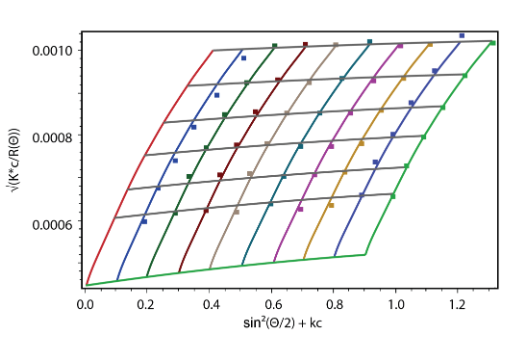
Some polymers are too fragile to run through a gel permeation chromatography (GPC) column without degradation, e.g., a macroligand which can dissociate from labile metals. Others, such as large PMMA molecules, may be too large for GPC. These materials can still be characterized by means of batch MALS, which determines weight-average molecular weight Mw and Z-averaged rms radius rg,z. Accurate determination of these values requires a 'Zimm plot' analysis, i.e., a measurement of light scattering intensity as a function of angle and concentration, without separation.
The traditional method for making Zimm plots involves manual preparation of a series of aliquots with increasing concentrations. Batch MALS measurements are made in a scintillation vial using the Batch Conversion Kit. Alternatively, in the microbatch method the aliquots are injected into the MALS flow cell. In either case ASTRA software analyzes the data via a global fit of all angles and concentrations to a single light scattering equation. The results include Mw, rg,z and the second virial coefficient A2 which indicates solute-solute and solute-solvent interactions.
Several convenient methods for making Zimm plots utilize automation to create a series of dilutions from a single stock solution, injecting the samples into the MALS and RI flow cells, acquiring the concentration and light scattering data automatically and calculating the three parameters. This automation may be carried out with the Calypso™ composition-gradient system or by programming an autosampler with a large injection loop.