Co-polymer Analysis
Co-polymers are not generally amenable to standard GPC analysis because no reference standards are available to represent elution time vs. molar mass. Even…
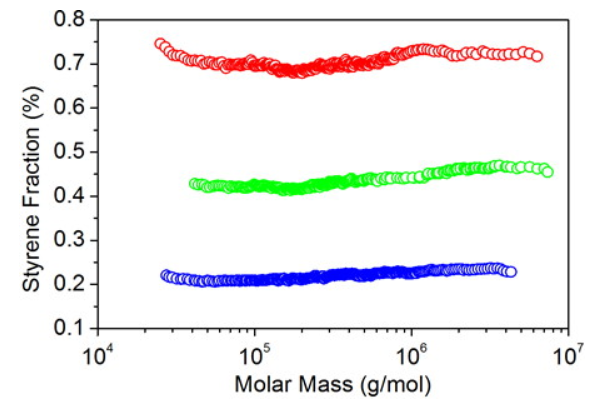
Co-polymers are not generally amenable to standard GPC analysis because no reference standards are available to represent elution time vs. molar mass. Even with standard SEC-MALS it is difficult or even impossible to analyze heterogeneous distributions of co-polymers, since in general dn/dc – a property that depends on the chemical composition but not the structure of the polymer, and a requisite parameter in MALS analysis – varies across the chromatogram unpredictably.
However, it is possible to carry out co-polymer analysis via the triple-detection system: SEC + UV-MALS-RI, or in some cases SEC + NIR-MALS-RI, if the two polymer components exhibit significantly different responses to the two concentration signals. In this scenario, the ASTRA™ software acquires concentration data from two distinct concentration detectors (ultraviolet UV and refractive index RI, or near-infrared NIR and RI). RI is measured via an Optilab differential refractometer, MALS is measured via a DAWN multi-angle light scattering detector, and UV or NIR via third-party online detectors.